David Dempewolf: ghost signals I–IV
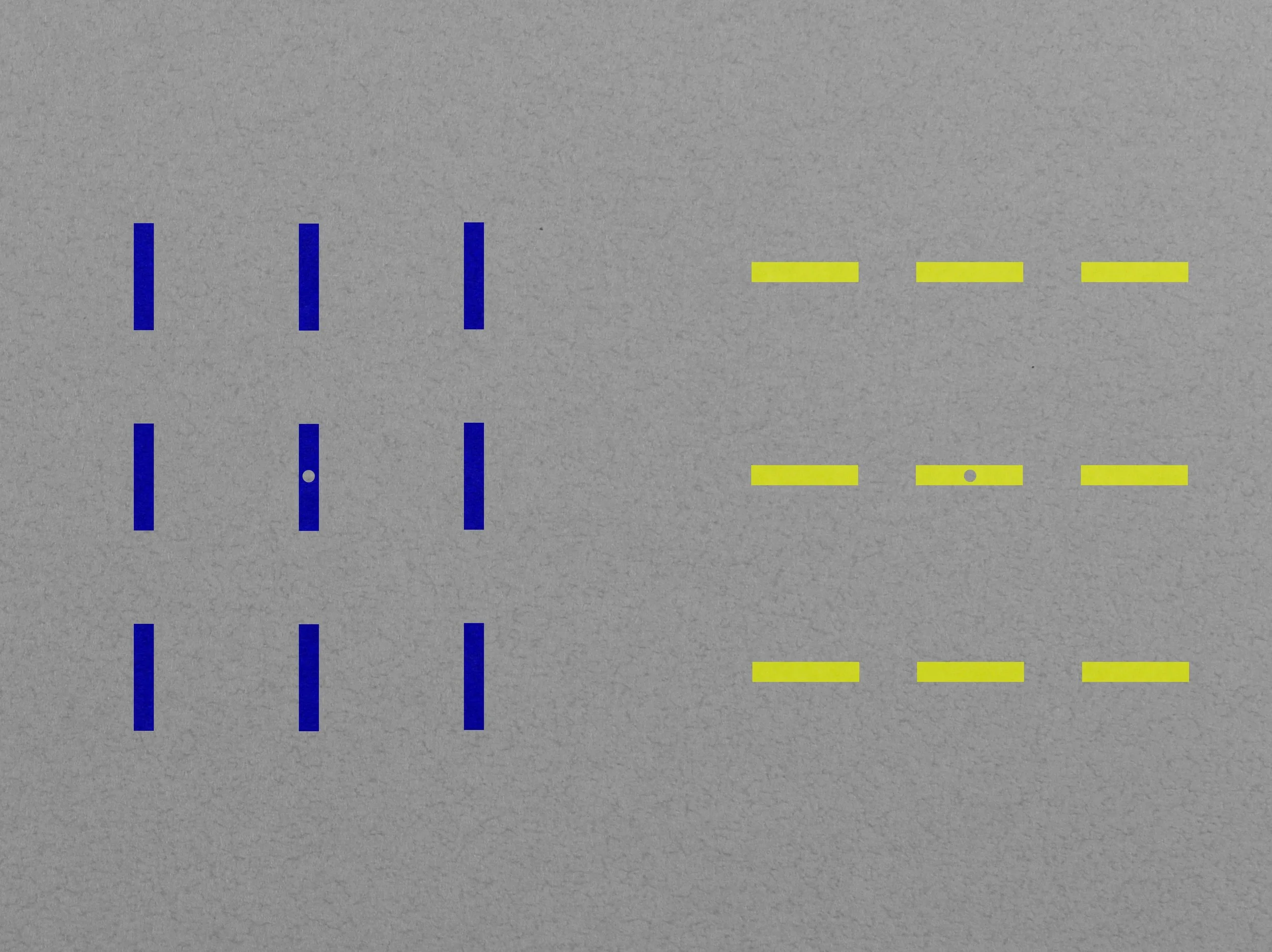
focus on a center dot until the edges of shapes glow, then shift to the next center dot and repeat
David Dempewolf: ghost signals I–IV
December 5, 2025 - January 31, 2026
First Friday Opening, Friday, January 9, 6-9 pm
Practice Gallery is pleased to present ghost signals I–IV, a new video installation by Philadelphia-based artist David Dempewolf.
ghost signals I–IV is a single-channel video that creates a space for the lived encounter of world and self, where perception exists neither entirely outside nor fully inside, but in a reversible intertwining of the two. The work employs high-chroma colored paper and geometric forms to elicit strong afterimages. The audio, produced in collaboration with artist/musician Richard Harrod, translates color into number and then number into musical pitch, so that each shade corresponds to a specific audible note, creating a synesthetic experience.
When one gazes at the bright color in the projected video, retinal cones (L for long-wave/red, M for medium-wave/green, and S for short-wave/blue) adapt, temporarily reducing their sensitivity. This imbalance produces complementary afterimages: red yields blue-green, green yields purple, and blue yields yellow. These afterimages typically fade within three to seven seconds, with blue–yellow lingering slightly longer. Signals from the retina pass through the lateral geniculate nucleus(1), preserving color opponency(2), and reach specialized regions in visual cortex area V4 (3), where small “globs”(4) respond to specific colors. The brain integrates these adapted signals with spatial context, generating the vivid, floating perception of an afterimage.
ghost signals I–IV enables viewers to perceive colored shapes through both the eyes and post-retinal visual processing, integrating internal and external vision. Afterimages remain fixed on the retina and preserved in the visual cortex, so when the eyes move, the perceived image no longer aligns with the current view, creating a spatial mismatch between past and present vision. The artist aims for visitors to have embodied experiences that heighten awareness of their body in relation to the screen.
notes:
1. A layered relay structure in the thalamus that receives input from retinal ganglion cells and sends organized, opponent-coded visual signals to primary visual cortex (V1). It preserves segregation of magnocellular (Motion, speed, luminance, no color), parvocellular (Detail, edges, red–green color), and koniocellular (Blue–yellow color, modulation) pathways and maintains color opponency (red–green/blue and blue–yellow) before cortical processing.
2. Signals from cone photoreceptors are combined into opposing pairs (red vs. green and blue vs. yellow) so that excitation of one side suppresses the other.
3. A mid-level region of the ventral visual cortex specialized for color and form processing. Neurons in V4 integrate opponent-coded inputs from earlier stages and respond to specific hues, saturation levels, and curvatures.
4. Small, spatially clustered patches within visual area V4 that contain neurons highly selective for specific colors or narrow hue ranges. These clusters form a mosaic of color-tuned modules that help support stable hue perception and fine-grained color discrimination.
Artist’s Bios
With formal training in sculpture from PAFA, a BFA from the University of Pennsylvania, and an MFA from Columbia University, Dempewolf has participated in the Whitney Independent Studio Program and the Skowhegan School of Painting and Sculpture. As a co-founder of Marginal Utility and a former member of the collaborative space Basekamp, Dempewolf is deeply engaged in collective and curatorial practices. David’s singular work investigates vision's nuanced mechanics, mimicking stereopsis, peripheral sight, global optic shifts, and mental imagery, while collaborations with Jazz musicians such as Jason Moran, Miguel Zenon, and Immanuel Wilkins demonstrate an expansive, interdisciplinary approach. Projects have been exhibited at venues including Greene Naftali, CAC Cincinnati, Locks Gallery, and international film festivals in Oberhausen and London. Dempewolf is currently the artist-in-residence at the Penn Center for Neuroaesthetics.
Richard Harrod holds an MFA from Tyler School of Art at Temple University and a BFA from the Cleveland Institute of Art. A PEW Fellow in the Arts and co-inventor of Blohard Gallery, he has presented three solo exhibitions with Marginal Utility Gallery.